Meadow Bank: Passive House Principles in a RIBA-Shortlisted Somerset Home

Back to blog

Performance, place and precision in a RIBA-shortlisted rural Somerset home

Some projects begin with a problem. Others begin with a place. Meadow Bank – a contemporary single-storey home near Bath, now shortlisted for the 2026 RIBA South West & Wessex Awards – began with both.
The site sits just beyond the development limits of its Somerset village, bordered by a stream, mature woodland and the grounds of a neighbouring farmstead. A previous planning application by another practice had been refused, so when architect Michael Williams of MJW Architects was brought in, the challenge was clear: design a home that could justify its presence in a sensitive rural setting while delivering the kind of energy performance the clients had set their hearts on.
The clients, a retired couple, came to Michael with a straightforward ambition: to build a low-carbon home shaped by Passive House principles, without pursuing formal certification. They wanted environmental responsibility built into the fabric of the house, not bolted on as an afterthought.
Norrsken supplied and installed a comprehensive package of triple-glazed aluminium-clad windows and doors to support the performance ambitions of the build.

Michael J Williams RIBA is the principal of MJW Architects. Based just outside Bath, the practice has specialised in residential, sustainable and Passive House architecture for over 25 years. Michael was appointed RIBA Sustainability Expert Judge in 2019 and has delivered certified Passive House projects including Four Oaks in Nailsea, the first in North Somerset.

Settling into the site

Rural architecture often demands a kind of restraint that urban projects simply don't require.

At Meadow Bank, the surrounding landscape – the stream, the lane, the proximity to listed and farm buildings – effectively determined the design. The house needed to earn its place.

"As an architect, I think the site determines the design," Michael explains.

"It's the garden of the farmhouse, so it's a contained setting – the stream on one side, the lane on the other, and then woodland beyond. We didn't want the house in the centre, because that would take up all the outdoor space. So it sits along two sides almost like a garden wall, single storey with a grass roof, just settling into the slope."

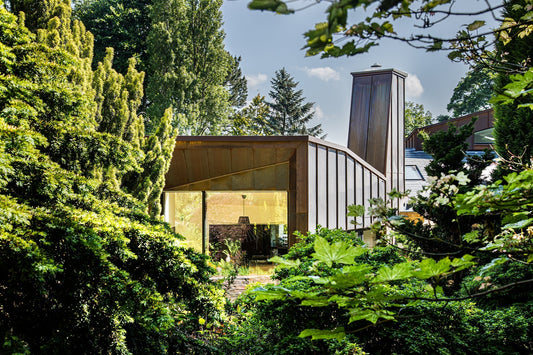
The result is a home arranged as two distinct wings – a living wing and a sleeping wing – connected by a glazed entrance link.

The L-shaped plan separates the more private bedrooms, which look towards the sheltered side of the site, from the living spaces, where longer views open towards the garden and stream. Local timber cladding wraps the exterior, and the grass roof ensures the building reads as part of the landscape rather than something imposed upon it.

Michael's 25-year track record in Somerset was instrumental in navigating the planning process. Having built an extensive network of relationships with local planners and building control officers, he was able to secure approval on appeal.

For self-builders considering a challenging rural site, there is a lesson here: local architectural expertise and a design that responds to its context can make the difference between a refusal and a home.

Designing with Passive House principles

The clients arrived with a clear ambition for low-carbon performance. Michael's practice had delivered a certified Passive House before – Four Oaks in Nailsea – and understood the rigour involved.

For Meadow Bank, the decision was to apply the same principles and methodology without pursuing formal certification, allowing a degree of flexibility in the design process while still delivering a home built around airtightness, thermal performance and controlled ventilation.

"The client came with that requirement," says Michael. "The whole concept of being airtight, of being able to control the airflow and the heating – that was a big desire from the outset. And that shapes everything, really. It's the difficulty of the detail that makes it work."

For anyone considering a similar approach, the cost question is inevitable. Michael's experience suggests the uplift is more modest than many assume.

"We say to our clients it's probably going to be 5 to 10 per cent more [for passivhaus-oriented builds]. It's difficult to do a direct comparison because we haven't priced the same project both ways, but timber frame construction – which is common in Passive House builds – is something we've been using across almost all our houses for years. It's a popular and cost-effective choice."

The distinction between a Passive House-informed approach and formal certification is worth noting. Certification requires extensive documentation and energy modelling to demonstrate compliance with the Passivhaus Institute's rigorous standards.

The Meadow Bank clients chose to invest in the physical performance of the building – high-performance glazing, meticulous airtightness detailing and careful material selection – without the administrative process of certification itself. The performance intent, however, was no less serious.

Why glazing specification matters

In a Passive House-informed build, glazing specification has significant implications for structural openings, solar control strategy, airtightness detailing and long-term comfort.

It directly affects orientation, planning and – in a project like Meadow Bank – the entire aesthetic character of the building.

At Meadow Bank, the triple-glazed alu-clad systems were specified to achieve low whole-window U-values suitable for a Passive House-informed build, while maintaining the slim frame profiles that the clients preferred.

"We looked carefully at the U-values – what was going to be achieved – and then we wanted the windows to be nice and slim, almost concealed within the cladding in places," Michael explains. "Some elements of the cladding go over the frame, some expose it, so it's just sleek."

For the larger openings, including the S315A lift-and-slide doors that connect the living spaces to the garden, the priority was smooth operation and thermal performance while bringing the outdoors as close as possible to the inside of the home.

The full Norrsken specification on the project included P31A and P33A triple-glazed alu-clad windows, S315A lift-and-slide doors, S309A and S307A glazed doors, and an S305A entrance door.

Externally, the frames are finished in RAL 7016 anthracite grey with a clear-stained timber finish internally – a combination that allows the windows to recede against the dark timber cladding outside while bringing natural warmth to the interior. The front door leaf in RAL 6021 pale green introduces a moment of colour at the entrance.

Managing solar gain and Part O compliance

Michael's approach was to push the glazing as far as the regulations would allow, then manage the consequences through intelligent design.

In practice, that meant balancing the clients' desire for generous openings against the requirements of Part O (the section of England's Building Regulations that governs overheating risk in new homes). The slatted timber brise-soleil is a beautiful detail – functional shading that doubles as architectural expression.

"We had to do the calculations to meet Part O, and the glazing is at the maximum, really. We all want lots of glass – myself, the clients – and then you're fighting against the overheating. So we brought in shading devices and in some areas the timber cladding extends over the glass, so you get lovely shadow effects coming through. The exposed area of glazing is reduced, but you still get that feeling of openness."

Which products are right for your project?

Take our short survey to discover the window and doors that differentiate developments.

Choosing a technical partner

Specifying high-performance glazing is one thing. Having confidence that it will be manufactured to the required tolerances, delivered to programme and installed to the standard a Passive House-informed build requires is another.

Michael is frank about why technical support matters as much as the product itself when sill details, frame-fabric interfaces and thresholds all need to maintain an unbroken thermal and airtight envelope.

"The technical background was very important – the provision of all the details, the CAD details, the advice. Having the trust that the windows are going to be designed to the correct sizes and then fitted well on site. We recommend Norrsken to our clients. They're not necessarily the cheapest, but we say go and visit the showroom, touch the doors, open them, see how they operate. These are big sliding doors – you need to feel the ease of them."

The importance of installation quality was underscored by a challenge on site. The timber frame manufacturer's openings were not perfectly square – an issue that required significant correction by the main contractor before the windows could be fitted to the required tolerances.

"There was a lot of correction needed to make the openings perpendicular and square for the windows to be fitted properly," Michael notes. "The main contractor put a lot of time into sorting that out."

It is a reminder that in a high-performance build, each trade's work is shaped by the rigour of the one before it.

A place to live well

Meadow Bank has been occupied for around a year, and the feedback from the clients has been positive.

"They're really enjoying it," says Michael. "Personally, I'm quite jealous – it's probably one of the closest projects I've done to the kind of house I'd like to live in. When family come, the grandchildren visit, they really enjoy it. It's meeting their needs."

The collaborative spirit that shaped the project extended to interior finishes.

Michael's idea of carrying the external timber cladding through into the hallway – blurring the threshold between landscape and home – is one of those details that elevates a well-built house into something more considered.

The glazed link between the two wings, though ultimately built with a solid roof at the client's preference rather than the originally envisioned glass, remains the hinge around which the whole plan pivots.

"I came up with the idea of taking the outside to the inside," Michael reflects. "The timber cladding in the hallway gives you that seamless connection between the two wings. It looks like you're still partly outside."

Building right the first time

Asked whether Passive House thinking will become more mainstream as UK building regulations tighten, Michael is measured in his response.

"It's difficult in the present climate. There's a conflict between the ambitions for new builds and the reality of the existing housing stock. A lot of older buildings simply aren't suitable for the same approach. And in heritage cities like Bath, where so many buildings are listed, you can't even install double glazing in some cases."

The tension between conservation and performance, between ambition and pragmatism, is a thread running through much of Michael's work.

But on new-build projects where the envelope is within the design team's control, his view is clear: early, coordinated specification of the building fabric – insulation, airtightness and glazing working as a system – is the foundation of a home that will harmonise with its environment and perform well for decades.

For homeowners pursuing a rural self-build shaped by Passive House principles, the lesson from Meadow Bank is that early coordination between architect and glazing partner can significantly influence both performance and design integrity.
Getting it right from the outset is what separates a good home from a truly exceptional one.

If you are designing a rural home shaped by performance from the outset, our technical team can support early-stage specification conversations. Get in touch to discuss your project.

Frequently asked questions

Can you build to Passive House principles without pursuing formal certification?

Yes, and it is an increasingly common approach.

The key principles – exceptional insulation, rigorous airtightness, controlled mechanical ventilation and high-performance glazing – can all be applied independently of the certification process. Certification requires extensive documentation and third-party verification to demonstrate compliance with the Passivhaus Institut's standards.

An uncertified approach invests in the physical performance of the building without the administrative overhead. The specification decisions at Meadow Bank were driven by Passive House thinking throughout, even though certification was not pursued.

Why does window specification matter so early in a Passive House-informed project?

In any build designed around airtightness and thermal performance, glazing specification has significant implications for structural openings, solar control strategy, compliance and comfort.

Window U-values and frame profiles affect the building's energy demand; glazing area influences Part O calculations; tolerances must work with the structural openings; shading can’t be finalised until the glazing is confirmed. These interdependencies mean that deferring glazing decisions to later stages creates costly rework and could compromise performance.

What is the difference between timber, aluminium and alu-clad window systems?

Timber windows offer excellent thermal performance and a natural finish, but require periodic external maintenance.

Aluminium frames are durable and low-maintenance, but conduct heat more readily and can create thermal bridging in high-performance builds.

Aluminium-clad systems combine both: a timber core for thermal performance and interior warmth, with an external aluminium skin for weather protection and long-term durability. This makes them particularly well suited to Passive House projects and exposed rural sites where maintenance access may be limited.

How does rural planning affect the design of a sustainable home?

Rural sites often sit outside settlement boundaries, near listed buildings or within designated landscapes – all of which impose additional planning constraints.

Achieving consent typically requires a design that responds sensitively to its context: respectful of scale, materials and character. At Meadow Bank, single-storey construction with a grass roof, local timber cladding and an L-shaped plan that follows the site boundaries were all shaped by the need to demonstrate that the home sits comfortably within its setting. Local architectural knowledge and experience with the relevant planning authority can be decisive.

Does building to Passive House principles cost significantly more?

The uplift is generally more modest than many self-builders expect.

Michael Williams of MJW Architects estimates an increase of around 5 to 10 per cent on overall build costs, though direct like-for-like comparisons are difficult because projects designed around Passive House principles tend to differ fundamentally in their approach to construction and specification. Long-term savings on energy bills and improvements in comfort and air quality should be weighed against any initial premium.

How does Part O affect glazing specification in a new-build home?

Part O of the England Building Regulations, introduced in June 2022, sets requirements for overheating mitigation in new residential buildings.

In practice, it places limits on the amount and orientation of glazing, particularly on south- and west-facing elevations.

For Passive House-informed builds that prioritise generous natural light and solar gain, Part O compliance needs to be considered from the earliest design stages. Glazing area, shading strategy and ventilation design all interact – and resolving them together, rather than treating Part O as a late-stage check, avoids costly redesign and ensures the home performs as intended.

Unmistakably trusted.

The highest compliment is a recommendation. These are the voices of those who placed their trust in us.

"Excellent Company from start to finish… If only every window supplier operated like this! I have used many others over the years on various projects but Norrsken far exceeded all of them… I hope this helps you make a decision for what is probably a large chunk of your budget… They are totally worth it"

See more

Angela Smith

Self Builder

“Having used Norrsken in the past we were happy to recommend them to one of our clients who was looking for the best sound proofing and weatherproofing they could get being set on a hill top overlooking the sea and facing strong westerly winds. They were not disappointed. A quality product, delivered well and on time. Thankyou.”

See more

Ken Pearson

Homeowner

"Fantastic professional service, from the original design to the final installation. The triple-glazed windows and doors that have been fitted to our new house are of a very high quality and look amazing. We definitely made the right choice when we decided to use Norrsken, nothing is too much trouble for them."

See more

Nigel

Homeowner

"I did my research before contacting Norrsken but they had come highly recommended by our Architect for our Passive House self build.

From the first meeting with Nick we felt confident that they were the Company for us."

See more

Ali and Brian Manning

Passive House Self Builders

“The quality of the triple glazed, alu-clad windows and doors is superb. They feel so reassuringly solid ... I opted for a wood stain for the internal finish on the frames, and am so glad I did, as it shows off the beauty of the wood perfectly. The whole process from order to installation went smoothly. I thoroughly recommend Norrsken.”

See more

Gareth

Homeowner

"Norrsken provided attentive service from drawings to on-site installation for our project at National Trust Stourhead and we would definitely recommend and repeat commission them on future projects."

See more

Charlotte Hill-Baldwin

Architect, H-B Designs

“From our very first interaction to the aftercare support, Norrsken has been exceptional. The quality of their windows is outstanding - beautifully designed, expertly crafted, and a real standout feature in our home. They've truly elevated the overall look and feel of the house.”

See more

Neil Southwell

Self Builder Homeowner